When you buy or sell real estate, the process does not end when the money is handed over and the keys are exchanged. There is a critical legal procedure that ensures the property officially and legally belongs to the new owner. This process is called Conveyance.
What is Conveyance and Why is it Important?
In simple terms, conveyance is the legal transfer of a property title from one person to another. It is the bridge between signing a contract and actually becoming the legal owner in the eyes of the law.
Without a proper conveyance process:
The sale is not official: Even if you paid for the land or unit, the government still sees the previous owner as the rightful holder.
Future sales are blocked: You cannot sell or mortgage a property that is not legally in your name.
Legal risks: You might be liable for taxes or legal issues attached to the previous owner.
Proper conveyance provides the legal security and peace of mind necessary for any major real estate investment.
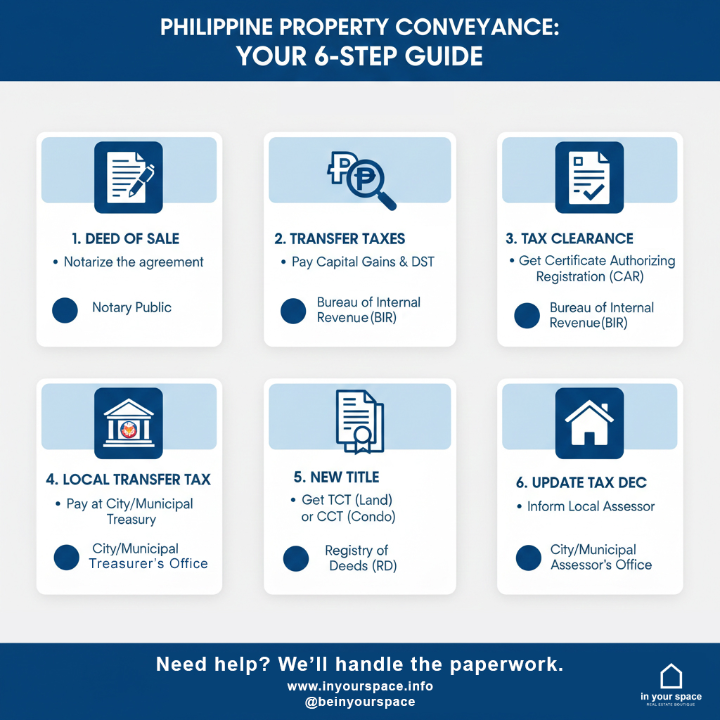
6 Steps to Transfer a Property Title in the Philippines
Navigating the bureaucracy can be overwhelming. Here is a simplified breakdown of the steps and the specific government offices you must visit to complete your transfer.
1. Notarization of the Deed of Sale
Once the buyer and seller sign the Deed of Absolute Sale (DOAS), it must be notarized. This turns a private document into a public instrument.
Government Office: Notary Public
2. Filing and Payment of Transfer Taxes
You must report the sale to the BIR to pay necessary taxes, specifically Capital Gains Tax (CGT) and Documentary Stamp Tax (DST). This must be done within a strict timeframe after notarization to avoid heavy penalties:
CGT Deadline: Within 30 days after the date of notarization.
DST Deadline: On or before the 5th day of the month following the date of notarization.
Government Office: Bureau of Internal Revenue (BIR)
3. Obtaining the Tax Clearance (CAR)
After the BIR verifies the payments, they will issue a Certificate Authorizing Registration (CAR). This is the essential "green light" document proving all taxes have been settled.
Government Office: Bureau of Internal Revenue (BIR)
4. Payment of Local Transfer Tax
Beyond national taxes, you must pay a local transfer tax to the city or municipality where the property is located.
Government Office: City or Municipal Treasurer’s Office
5. Transfer of the Title (TCT or CCT)
Once you have the CAR and local tax receipts, you submit them to receive a new title in the buyer's name. Depending on the property type, you will receive:
Transfer Certificate of Title (TCT): For land or a house and lot.
Condominium Certificate of Title (CCT): For condominium units.
Government Office: Registry of Deeds (RD)
6. Updating Tax Declarations
Finally, you must inform the local assessor that the owner has changed. This ensures that future Real Property Tax (RPT) or "Amortization" is billed to the correct person.
Government Office: City or Municipal Assessor’s Office
Let Us Handle the Paperwork
Conveyance involves a lot of legwork: queuing in government offices, checking document accuracy, and ensuring deadlines are met to avoid fines.
At in your space, we specialize in making property ownership seamless. If you need assistance with conveyance, title transfers (TCT/CCT), or general consultancy, we are here to help. You focus on your new home or investment; we will handle the government filings for you.
Ready to start your transfer? to ensure your property title is processed correctly and on time.